What is a Story-Based Community Group?
A Story-Based Community Group is not therapy. It's a slow, thoughtful way of engaging your story where you are truly seen, witnessed, and formed in community.
STORY WORKSTORY & FORMATIONCOMMUNITY & CONNECTIONSPIRITUAL FORMATION
What Is a Story-Based Community Group?
If you've followed me for any time at all, you've probably noticed a few phrases showing up consistently: Story Work, confessional community, empathetic witness. And you may be wondering: what does any of that actually look like in practice?
The Story-Based Community Group is the heart and soul of what Story Work in Progress exists to offer. It's where the concepts become lived experience. And before I tell you what it is, I want to start by telling you what it isn't.
This Is Not Therapy
A Story-Based Community Group is not a therapy group, and it's not a replacement for therapy. If you're working with a therapist, this can be a powerful companion to that work. If you've never been in therapy, that's okay too. This is something different.
Traditional therapeutic approaches, and behavior-based models especially, often focus on helping us manage our reactions. They ask: how do we respond differently? How do we change our behavior? Those are worthy questions and real tools have come from them, but that’s only a small piece of the puzzle and can be short-lived and even unfortunately reinforce some of the places we are most stuck.
Story-Based Community Groups ask a different question first. Why is this reaction here at all? What story is living underneath it? Where did it come from, and what has it been trying to protect?
This is thoughtful, slow work. It is not a rapid solution and it won't "fix" you, because you are not broken, you are being formed. What it will do is help you begin to understand yourself more fully, and from that understanding, start to determine what your next right steps might be.
Standing on the Shoulders of Giants
This work doesn't exist in a vacuum. It has been deeply shaped by two bodies of work I return to again and again.
The first is the work of Dr. Curt Thompson, psychiatrist and author, whose exploration of neuroscience, attachment, and what it means to be truly known has profoundly influenced how I think about story, community, and transformation. His work through the Center for Being Known and books like The Soul of Desire and Anatomy of the Soul form much of the theological and neurological foundation underneath these groups. The confessional community groups offered by the Center for Being Known were instrumental in my learning, practice and desire to forge more spaces where that meaningful work can continue, grow, and flourish.
The second is the work of The Allender Center, whose Narrative Focused Trauma Informed Story Work model has shaped how I understand the way our past shows up in our present, how being witnessed by someone who understands how past harm and trauma can shape our present, and when that person can name those places of harm with kindness and honesty, then caring for those stories can begin to reframe what we believe to be “true” about ourselves.
A Story-Based Community Group draws from both of these influences. It also weaves in additional layers including somatic practices that help us pay attention to what our bodies are telling us in real time. That combination makes this a distinct offering, one I've developed through years of personal experience, training, and participation in multiple group modalities.
So What Actually Happens in the Room?
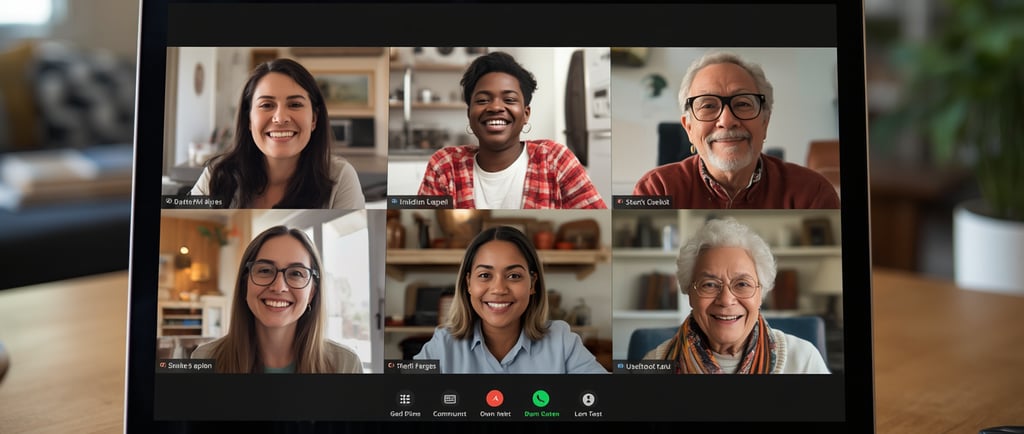
Groups are small by design, no more than six people. That size is intentional. It creates the conditions for real safety, real attention, and real witness. You are not lost in a crowd. You are seen.
Each group runs for eight weeks, meeting for 90 minutes at a time. The pace is slow and deliberate. We are not rushing toward conclusions or trying to solve anything quickly. We are learning to notice, name, and be present together.
A significant part of the work involves paying attention to what's happening in your body. Not in a clinical or complicated way. You don't need any prior experience or special vocabulary for this. Just a willingness to begin noticing and be curious. When something activates you in the conversation, where do you feel it? Is there a tightness, a heaviness, a catch in your breath? Your body has been holding your story for a long time. Part of this work is learning to listen to and name it.
And then there is the witnessing itself. Sharing what you notice. Having it received by others who are not there to fix you, advise or dismiss you, or spiritually bypass and minimize what you have experienced. That experience of being truly seen in community, not just in a one-on-one setting, does something that is difficult to put into words and nearly impossible to manufacture anywhere else.
What Do You Need to Come In?
Not much, honestly.
You don't need a certain level of self-awareness. You don't need prior therapy or Story Work experience. You don't need the right vocabulary or a fully formed sense of your own story.
You need three things. A willingness to be curious about yourself. A beginning openness to notice how your story shows up in your body. And a desire to be present, to be seen, and to offer that same presence to others in the room.
That's it. That's the baseline. Everything else unfolds from there.
Why Community?
You might be wondering why this happens in a group rather than one-on-one. It's a fair question.
The answer is that something specific happens when we are witnessed not just by one person, but by a community of people who are also doing this work. There is a particular kind of transformation that comes from realizing you are not alone in your story and that others remaining present will reveal parts of you that you didn’t know existed and will even go with you outside of the group. Learning that others carry similar knots, similar old narratives, similar moments of feeling outside the crowd or not enough means you are no longer alone.
Being known in community begins to transform the story we believe about ourselves in ways that solitary work simply cannot replicate. It reaches something deeper. It tells a different story back to us, one that says: you belong here, your story matters, and so do you.
That is what a Story-Based Community Group exists to provide.
Ready to Learn More?
If something in this resonated with you, I'd love to stay connected. Sign up to be the first to know when new groups are forming. You don't have to have it all figured out. You just have to be willing to begin.
Life Happens. Story Matters. Let's Human Together.
ADDRESS
PO Box 913 Bethel St. #391
Clover, SC 29710
CONTACT
lita@storyworkinprogress.com